
Water Sort: Master Colors
Bobodoo GamePuzzle
4.9965.00 Reviews
- Version
- 1.0.34
- Installs
- 1.00M
- Age Rating
- Everyone
Screenshots


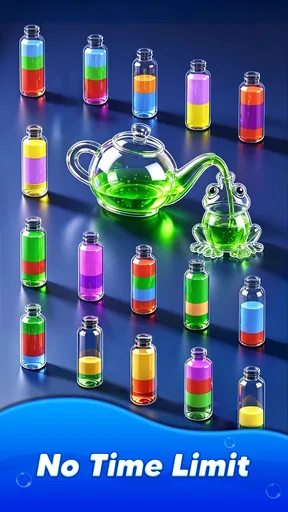
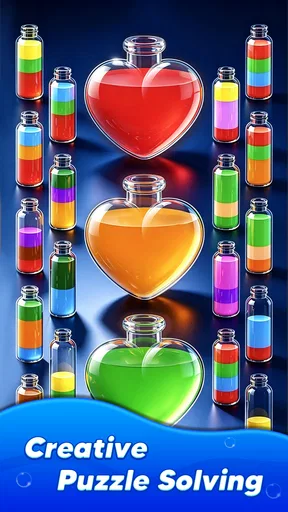
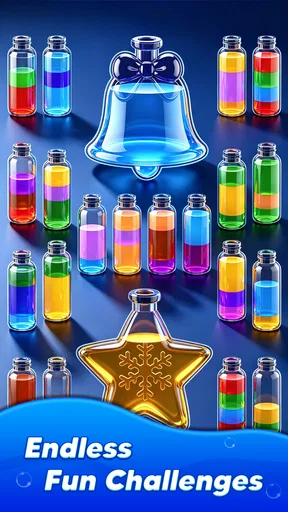
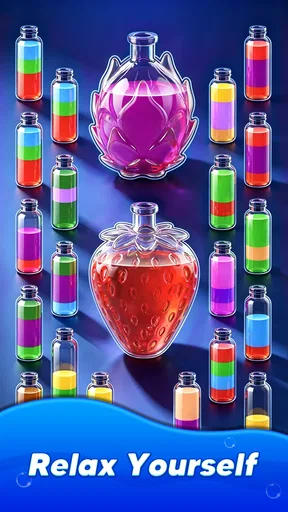
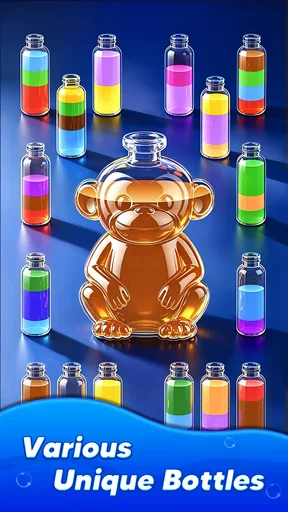
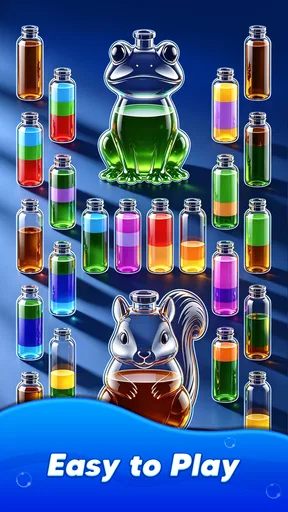
Our Review of Water Sort: Master Colors
 Analysis by Appyee
I spent time with Water Sort: Master Colors as a simple, pick-up-and-play puzzle, and my first impression was clear: this is aimed at people who enjoy arranging things until every piece falls into place. The idea is easy to understand, but the decisions become more demanding once a bottle has limited room and one careless pour blocks the color you need next. It feels comfortable as a short break rather than a game that asks for a long, uninterrupted session.
It is a free puzzle game from Bobodoo Game, rated for Everyone and available for devices running Android 7.0 or later. The game has reached over a million installs and holds a 4.9 average from around 57 thousand ratings, which suggests that its straightforward format has found a broad audience. I would still treat those figures as a sign of popularity, not a guarantee that every player will enjoy the same pace or presentation.
How the current puzzle experience feels
Each level revolves around colored liquid in bottles. I select a bottle, choose where to pour it, and try to group matching colors without filling a container in a way that leaves the remaining arrangement impossible. The controls are immediately understandable, so there is no learning curve between opening the game and solving the first few boards.
That simplicity is one of its strongest qualities. I can play while waiting for an appointment, during a short commute, or when I want something quieter than an action game. A level does not require the same attention as a story-driven adventure, but it still gives me a small problem to think through. The best moments come when I recognize that a temporary move, which appears to make the board messier, is actually necessary to expose the color underneath.
The game belongs firmly to the sorting puzzle category, but the bottle format gives each decision a physical feeling. Empty space matters. A spare bottle is not just another container; it is the room that lets me rearrange the board. When that space disappears, I have to stop making moves automatically and consider the order of the next several pours.
I found it useful to read a level from the bottom upward. Instead of chasing the color that is easiest to see, I look for the hidden layer that will become available after a bottle is cleared. This small change in habit prevents many unnecessary moves. It is also the kind of practical insight that is easy to miss if you treat the game as a sequence of quick taps.
Small decisions make the difference
The most reliable approach is to avoid completing a color too early if doing so uses the only useful space on the board. A finished bottle looks satisfying, but it can also become a dead end when another color needs that same temporary capacity. I usually keep one bottle flexible until I understand which stacks are blocking the others.
Another useful habit is to group only when the move improves access. Pouring two matching layers together feels efficient, yet it may hide a different color that needs to be moved first. I get better results when I ask, “What does this pour reveal?” rather than simply asking whether it creates a larger color group.
For an everyday example, I might open the game with a few minutes before dinner. I can solve one board, stop without losing the value of the session, and return later for another short challenge. It works particularly well in that situation because there is no complicated story to remember and no team or opponent waiting for me. The trade-off is that players who want a strong sense of progression or a dramatic payoff may find the experience too restrained.
What the current release tells me
The current version is 1.0.25, while the game’s listed release date is March 13, 2026. That places the app in a relatively early stage of its life, so I would judge it mainly by the quality of the core loop rather than by expecting a large history of established systems. The important question for me is whether the basic sorting remains pleasant after the novelty fades.
At present, the answer depends on what you want from a mobile puzzle. If you like calm repetition, the bottle arrangement is easy to return to. If you need constantly changing rules, elaborate objectives, or a story campaign, the central mechanic may feel narrow. The version number shows that the app has a defined current build, but it does not by itself tell me that the game has transformed into a broader puzzle platform. I would keep expectations focused on sorting colored liquid.
The store summary describes many creative bottles, and that gives the presentation a more playful identity than a completely bare logic exercise. Still, the lasting value comes from how the boards are arranged, not from the bottle theme alone. A decorative change can make a level look fresh, but it cannot replace thoughtful puzzle structure. I pay attention to whether a new-looking board actually changes my decisions or merely changes the surface.
For someone already playing an earlier build, the current release should be approached as a refinement of the same basic experience rather than as a reason to relearn an entirely new game. The familiar controls are an advantage because returning players can start solving immediately. The limitation is equally clear: anyone hoping for a radically different style of play may not find enough change in the central action.
Where it fits beside other sorting games
Compared with a traditional match-three puzzle, this game is slower and more deliberate. Match-three games often reward quick pattern recognition and chain reactions, while this one rewards planning around space, order, and blocked layers. I prefer the bottle format when I want control over every move and do not want the board to change unexpectedly after a large combination.
Compared with a paper logic puzzle, it is more convenient because the app handles the containers and pours for me. I do not need to draw a board or track the state manually. On the other hand, a paper puzzle can offer more variety in its rules, and a dedicated logic title may feel more intellectually demanding. This game is better for a light mental reset than for someone searching for a deep collection of different puzzle types.
It also differs from competitive puzzle games because the pressure comes from the arrangement itself, not from another player. That makes it suitable for people who dislike timers, rankings, or direct competition. The downside is that there is less external urgency. If your motivation depends on beating a rival or improving a visible score, a competitive alternative may hold your attention longer.
The main trade-off is calm accessibility versus long-term variety. I can recommend it confidently as an easy-to-start sorting game, but I would not present it as a replacement for every kind of puzzle experience.
Practical habits for solving difficult boards
When I reach a board that seems stuck, I stop pouring for a moment and map the available spaces mentally. I identify which bottles contain a single visible color, which ones have mixed layers, and where the empty capacity is located. This pause is more valuable than tapping through several hopeful moves, because a bad pour can force a restart or consume a helpful option.
I also protect the bottle that gives me the most freedom. If there are two empty containers, it is tempting to use both immediately. I usually reserve one as a buffer and use the other to expose layers. That creates a safer rhythm: one bottle supports the rearrangement, while the other remains available if an unexpected blockage appears.
A third technique is to finish the most constrained color first, not necessarily the largest group. A color buried under several unrelated layers can become the real obstacle later. Moving it into a safe position early may look less rewarding than combining an obvious pair, but it reduces the chance of reaching an awkward end state.
These methods also show why the game can be more thoughtful than its short description suggests. The interface stays simple, yet the player can develop a repeatable solving process. I do not need advanced gaming skills, but I do need patience and a willingness to undo my first instinct when the board demands it.
What may frustrate some players
The free price makes the game easy to try, but in-app purchases range from $1.99 to $69.99 per item. That is worth keeping in mind before spending time in the game. I would approach any optional purchase carefully and decide whether it genuinely improves my experience rather than buying simply because I am stuck on one arrangement.
The game is also not ideal for people who want a rich narrative, character development, or a large collection of unrelated mechanics. Its identity is concentrated around pouring and grouping colors. That focus helps the game feel coherent, but it can also make repeated sessions feel similar if you prefer constant novelty.
Players who dislike restarting a puzzle after a poor sequence may need to be especially deliberate. The safest way to play is to treat the first few moves as setup rather than as a race toward completed bottles. I would skip this title if I know I become impatient with trial-and-error sorting, because the pleasure depends on thinking through consequences instead of tapping rapidly.
It is also worth considering the age rating. Because it is suitable for Everyone, it can work as a family-friendly casual puzzle, but that does not mean every child will find it equally engaging. Younger players may enjoy the colors and direct controls, while older players may appreciate the planning element more. I would choose it for a child who likes arranging and categorizing, not simply because the rating is broad.
Who should download it now
I would recommend this game to someone who wants a quiet mobile activity with rules that can be understood immediately. It is a good fit for short sessions, relaxed concentration, and players who enjoy solving a problem through order rather than speed. It is also friendly to people who do not normally play games because the basic interaction is so easy to grasp.
I would be more cautious about recommending it to a player who needs a strong sense of discovery after every level. The bottle theme and board layouts can provide enough variation for casual use, but the core action remains consistent. In that case, a broader puzzle collection or a logic game with several rule sets may offer better value.
For existing users, the current release is worth trying if they enjoy the established bottle-sorting loop and want to stay on the latest available version. I would not promise a completely new experience based solely on the version number. The sensible expectation is a continued, focused puzzle game whose success depends on the quality and variety of its arrangements.
For new users, the decision is simple: try it because the entry barrier is low, then judge whether the repeated sorting rhythm suits you. The free download removes much of the initial risk, while the optional purchase range makes it sensible to keep spending under control. I would play several sessions before deciding whether any paid addition is worthwhile.
My closing view
Water Sort: Master Colors works because it does not complicate its central idea. I pick up a bottle, plan around empty space, and gradually turn a mixed arrangement into organized colors. In my experience, the most rewarding part is not the final completed bottle but the moment I see a route through a board that initially looked blocked.
Bobodoo Game has a focused casual puzzle here, and the current version presents that idea in a form that is approachable for a wide audience. Its strong reception and popularity support its appeal, but my recommendation rests more on the hands-on rhythm: it is easy to start, comfortable in short bursts, and capable of making me think without becoming overwhelming.
I would choose it for a few quiet minutes, a child or adult who enjoys sorting, or anyone who prefers solitary puzzles to competitive games. I would look elsewhere for a story-rich adventure, fast reactions, or a wide range of puzzle mechanics. As long as you understand that its strength is focused repetition rather than endless reinvention, this is a pleasant free puzzle to keep available when you want a small problem and a satisfying solution.
Privacy and Permissions
See what permissions an app requests and how it handles your data.
- Wi-Fi connection information
- view Wi-Fi connections
- Other
- view network connections, full network access, control vibration, prevent device from sleeping, Google Play license check
Verdict
Strengths of Water Sort: Master Colors
- Simple rules make it easy for anyone to start playing.
- Short levels are convenient for quick breaks or casual sessions.
- Bright liquid colors make the tubes easy to distinguish.
- Increasing difficulty provides a steady sense of progression.
- Offline play is useful when a stable internet connection is unavailable.
Limitations of Water Sort: Master Colors
- Later puzzles can feel repetitive because the core mechanic rarely changes.
- Some levels may require trial and error rather than pure logical planning.
- Ads can interrupt the flow, especially between completed puzzles.
- The game offers limited variety beyond sorting colored liquids.
- Accidental tube taps can undo a carefully planned move.
Other Releases by Bobodoo Game
View All
Water Sort! Color Sort Puzzle
Puzzle4.9
Similar Picks in This Category
View All
Block Blast!
HungryStudio4.8

Braindom: Brain Games Test
Lahana Game Studio4.6

AMAZE!
CrazyLabs LTD4.6

Sudoku - Classic Sudoku Puzzle
Oakever Games4.7

Art Puzzle - Puzzle Games
Easybrain4.8

Amaze GO!
Oakever Games4.9
Frequently Asked Questions
What is Water Sort: Master Colors and how do you play it?
Water Sort: Master Colors is a color-sorting puzzle game in which you pour liquid between bottles until each bottle contains only one color. The rules are simple, but later levels require careful planning because you have limited empty containers and cannot pour onto a different color. It is designed for short sessions, although increasingly complex puzzles can take considerably longer to solve.
Is Water Sort: Master Colors free to download and play?
The game can generally be downloaded for free, but availability of advertisements, optional purchases, and specific monetization features may depend on the version installed and the platform. Players should check the current store listing before downloading. The core sorting puzzles are usually accessible without payment, while ads may appear between levels or when using extra hints, undo actions, or other convenience features.
Does Water Sort: Master Colors work offline?
Many of the game’s basic sorting puzzles can usually be played without a continuous internet connection, making it suitable for travel or quick offline sessions. However, an internet connection may still be required for advertisements, analytics, cloud-related features, updates, or restoring purchases. If offline access is important, test the game after installation and avoid assuming that every feature will remain available without a network.
Are there hints, undo options, or ways to restart a difficult level?
Water Sort: Master Colors typically provides practical tools for correcting mistakes, such as undoing recent moves, restarting a puzzle, or receiving a hint. Their exact availability and cost can vary by version, and some may require watching an advertisement or spending in-game resources. Even with these aids, the main challenge remains planning several moves ahead rather than pouring colors randomly.
Is Water Sort: Master Colors suitable for children and casual players?
The game is easy to understand and does not normally require fast reflexes, making it appealing to casual players and people who enjoy relaxed logic puzzles. Nevertheless, parents should review the age rating, advertising behavior, and any in-app purchase settings before allowing children to play. Some advanced levels can be surprisingly challenging, so younger players may need help with strategy or patience.
Play our best games!


